



Pick up a corner of a front-loader. You will feel it immediately. That is not a design flaw. It is physics.
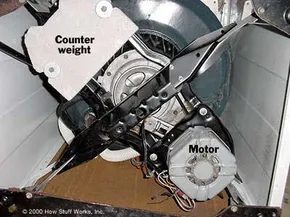
Inside the drum, there is a block of concrete. It looks like a mistake, but it serves one purpose. The concrete balances the electric motor. The motor drives a heavy gearbox. The gearbox attaches to the steel inner tub. Every component adds mass.
The concrete is there to balance the equally heavy electric motor.
What holds your clothes
Your clothes live in the inner tub. It is not a sealed bucket. The sides are perforated with holes. When the tub spins, water leaves through those openings. In the middle, you will find the agitator. It moves the laundry through the water.
The outer tub is different. It seals in all the water. Technicians bolt it directly to the body of the washer. This creates the barrier between your laundry and the floor.
Why the tub moves
Here is the problem. The inner tub vibrates and shakes during the wash cycle. If it were fixed rigidly, it would bang into other parts of the machine. The mount allows movement. This lets the tub shift without causing structural damage.
The gearbox connects the inner tub to the black metal frame. That frame holds three things:
- The motor
- The gearbox
- The concrete weight
This assembly is why a washing machine is so heavy to move.
How the drum suspension keeps your washer from shaking
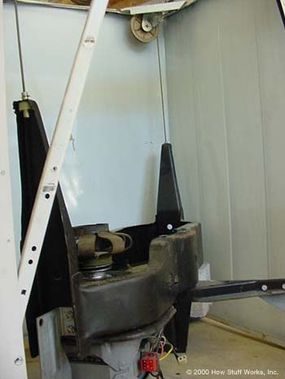
Look at that bare black frame. No tub. No gearbox. Just steel. The cable wrapping around the left side connects directly to the right. It’s one continuous loop. Three pulleys manage the geometry.
Lift one side, the other drops. It’s a see-saw mechanism designed to absorb the weight of the heavy drum assembly. The system isolates the moving mass from the main chassis.
Why doesn’t the tub swing wildly every time a load shifts?
Damping friction controls the movement
Hanging by cables alone would make for a chaotic pendulum. Instead, the machine uses a damping system. Friction converts kinetic energy into heat. It eats the vibration before it travels to the floor.
- Cables handle the static load.
- Pulleys manage direction.
- Dampers kill the oscillation.
This setup allows the drum to move slightly under load without transferring that jolt to the frame. You don’t need to rebuild the suspension, but understanding it helps when you’re diagnosing excessive noise. If the machine bounces, the dampers might be worn. Check the friction surfaces. Keep the area clean. Dust reduces efficiency.
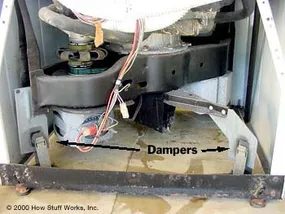
Understanding the Shock Absorber Mechanism
Look at the four corners of your washing machine. Each one holds a mechanism that functions a lot like a disc brake on your car. The component attached to the washer frame is a spring. It squeezes two pads against the metal plate attached to the black frame.
You can probably see where the pads have polished the plate from movement during vibration. That shine is proof the system is working. It’s converting kinetic energy into heat, slowing the drum down before it hits the walls.
If you’re replacing these, check the pad material. Wear is uneven. One side might be smooth while the other is rough. You want new pads that match the original spec. The spring tension matters too. If it’s weak, the pads won’t press hard enough. The machine will shake.
Testing Your Motor Knowledge
Do you actually know what’s happening inside that motor? Most people assume it’s just spinning a drum. It’s doing a lot more. It’s controlling speed, torque, and direction.
Give yourself a minute.
- Can you identify the difference between a brushless motor and a brushed one?
- Do you know why some machines use a direct drive system?
- Can you spot a failing capacitor from the sound alone?
If you’re unsure, that’s normal. The electronics are getting smarter, but the physics hasn’t changed. Friction is friction. Mass is mass. Understanding the basic mechanics helps you troubleshoot before you call a repairman. It saves you money and keeps you from buying parts you don’t need.