



Water doesn’t forgive mistakes. If you sink, you drown. On a houseboat, the stakes are higher because you aren’t just floating; you’re living. One wrong calculation and your kitchen is underwater.
Fortunately, physics has your back. But understanding how a houseboat stays afloat isn’t just trivia. It’s the difference between a comfortable weekend trip and a frantic salvage operation.
The Basics of Floating
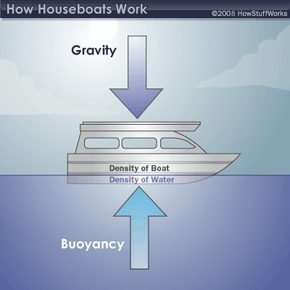
The secret is buoyancy. You’ve felt it. Push down on a floating object. It resists. Let go, and it bounces back up. That’s the water pushing up against the hull with the same force the object pushes down on it.
When the weight of the displaced water equals the weight of the boat, equilibrium happens. Float.
Too heavy? Sink.
Most DIYers build houseboats from fiberglass or wood. Why? Because these materials are light. Low density means easy buoyancy. You aren’t fighting the water; you’re letting it support you.
Why Houseboats Tip Differently
Staying afloat is step one. Staying upright is step two.
Land is flat. Water is chaotic. Waves throw a boat around. A regular sailboat handles this by keeping its center of gravity lower than its center of buoyancy. Heavy ballast in the keel pulls the bottom down. Light mast stays up. Stable.
Houseboats are different. They sit on pontoons or a raft-like hull. The living space is on top. Heavy furniture, water tanks, people. The center of gravity is higher than the center of buoyancy.
Unstable? Not necessarily. But it requires careful planning.
Designing for Stability
If your houseboat tips like a lawn chair, you have a problem. The higher the center of gravity, the wider the base needs to be.
Think of it like a pyramid. Wide base. Narrow top. Hard to knock over.
Houseboats often use wide pontoons to lower the center of buoyancy relative to the hull’s weight. This creates a righting moment. When the boat tilts, the buoyant force shifts to the lower side, pushing it back upright.
Key Factors for DIY Builders
- Weight Distribution : Heavy items low and centered. Avoid stacking heavy gear on the roof.
- Hull Width : Wider pontoons increase stability. Narrow hulls tip easily.
- Material Choice : Fiberglass is durable and light. Wood is traditional but heavier. Balance is key.
- Freeboard : Ensure enough hull height above the waterline to prevent swamping in waves.
The Role of Pontoons
Most DIY houseboats use twin or triple pontoons. These sealed tubes provide the buoyancy. They’re simple. Easy to build or modify. But they have limitations.
Wide pontoons = stability.
Narrow pontoons = speed (and instability).
You can’t have both. Pick your priority.
Maintenance Matters
Buoyancy isn’t static. It degrades.
Leaks are the enemy. Check seals regularly. Inspect pontoons for cracks. Saltwater corrodes metal fittings. Freshwater rots wood. Protect your investment.
A small leak in a pontoon changes the center of buoyancy. Suddenly, your
The Physics of Staying Afloat
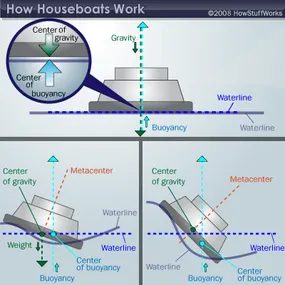
When a houseboat leans right, the water doesn’t just stay still. The center of buoyancy shifts right too. Suddenly, you have water pushing up against the starboard side instead of the center. It feels like the water is trying to lift the hull out of the lake. The further out that push extends, the more likely the craft is to capsize.
Look at the diagram. You will see the center of gravity and the center of buoyancy intersect. This point is the metacenter. It is a critical threshold. The lower this intersection sits, the closer the boat is to tipping over. If the metacenter drops below the center of gravity, the boat goes down.
Fortunately, this doesn’t happen during a normal breeze. It requires extreme weather. Think large waves. Strong winds create the kind of chaos that could easily flip a houseboat. This is why you won’t find marinas in areas prone to such violent weather. Safety first.
The metacenter is the intersection of the center of gravity and the center of buoyancy. If it drops below the center of gravity, the boat tips.
There is another force at work here. The righting moment. It forces the boat’s weight back down. It keeps you upright. You can calculate this force. It is simple math. Take the weight of the center of gravity. Multiply it by the distance between the two centers.
Let’s look at the numbers. A 15,000-pound boat shifts its center of buoyancy out three feet. That creates a righting moment of 45,000 pounds per foot. That is a massive amount of power. The farther the center of buoyancy swings from the center of gravity, the harder that righting moment works. It fights back.
A 15,000-pound boat shifting its buoyancy center out three feet generates a righting moment of 45,000 pounds per foot.
This physics isn’t just theory. It’s why your vessel stays on the surface. But understanding the structure is only half the battle.
To learn about houseboat maintenance and the rules and regulations you can expect aboard one, see the next page.