




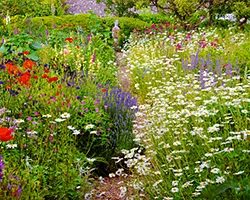
Deciding on a garden style can feel like trying to pick a favorite child. You might want the romantic chaos of an English cottage, the rigid precision of Versailles, or the meditative stillness of a Zen retreat. The good news is that you don’t need a landscape architecture degree to pull off any of these looks. You just need to pick one and stick to its rules.
The Unfussy English Cottage Garden
If your idea of a perfect Saturday involves getting your hands dirty and not caring much about symmetry, the English cottage garden is your match. This style emerged in the early 1700s as a rebellion against the strict, geometric formal gardens of the aristocracy. It’s about naturalism.
To get this look, you need to embrace the “overgrown” aesthetic. But don’t let that fool you into thinking it’s neglect. It’s curated chaos. You want climbing plants and ivy spilling over structures. Use arbors, trellises, and wooden benches as focal points. The layout should be asymmetrical.
The key is to let plants grow together. They should compete for light and space, creating a dense, lush carpet of color. However, you still have to tend to them. Weeding and pruning are essential, even if the end result looks wild. If you leave plants completely untended, it stops being a cottage garden and starts being a junkyard.
Materials here lean rustic. Think weathered wood, stone paths that are slightly uneven, and terracotta pots. Avoid shiny metal or plastic. The goal is to make it look like the garden has been there for centuries, quietly taking over the house.
The Formal French Garden
This is the opposite of the cottage style. If you can’t stand a crooked hedge or a weed in the grass, you want the French style. Think of the gardens at Versailles. They are defined by control, geometry, and hierarchy.
The foundation of a French garden is the planting bed. These must be laid out in precise geometric shapes—circles, squares, or intricate parterres. They are bisected by crisp, straight walkways. The lines must be sharp. If a path curves, it needs to be a mathematically perfect arc, not a meandering dirt track.
Water features are not optional here. You need fountains or reflecting pools that mimic the grandeur of King Louis XIV’s court. The water should be still or sprayed in precise jets, not bubbling over random rocks.
Plant selection matters. You can include vegetables, but they must be planted in orderly rows. Celeriac, asparagus, and leeks are traditional choices. For color, stick to lavender, roses, and climbing vines that are trained to grow on walls or trellises in strict patterns.
Tools for this style include stiff-bristle brooms for sweeping gravel paths, heavy shears for boxwood hedges, and a laser level to ensure your beds are truly straight. The maintenance is higher. You are constantly fighting against nature’s tendency to grow wild.
The Peaceful Japanese Zen Garden
Japanese gardens are not just about looking pretty. They are designed to facilitate Zen Buddhist philosophy. The goal is peace, reflection, and a connection to nature’s underlying principles.
These gardens are often enclosed by hedges or fences to create a private sanctuary. Inside, the focus is on balance. Evergreen plants provide year-round structure and color, while seasonal blooms like irises and lilies add temporary accents.
Water is central, but it’s handled differently than in the French style. Whether you use a fountain, a pond, or a simple water basin (tsukubai), the flow should be gentle. The water should move from east to west, following the path of the sun. This is a specific directional requirement that grounds the design in traditional practice.
Rocks are arguably more important than plants. They represent mountains, islands, or stability. You cannot just throw rocks anywhere. They must be placed with intention, often in odd numbers (3, 5, or 7) to create a sense of natural asymmetry. Use natural stone, not concrete pavers. The earth should be visible, often raked gravel or moss, not lush green lawn.
The materials here are raw and unpolished. Wood, stone, and water. Avoid bright, artificial colors. The palette should be muted: greens, grays, browns, and the white of raked gravel.
Which Style Fits Your Space?
There is no single right answer. The English style works best in larger spaces with natural contours. You need room for the “chaos” to breathe. If you have a small, flat backyard, the English style might feel cramped or messy.
The French style requires flat, open ground. You cannot easily execute geometric precision