



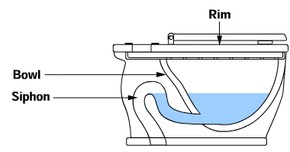
Forget the tank for a second. Imagine your toilet is just a bowl sitting there, no water supply, no handle, no magic box behind it. It still works. That’s because the heavy lifting is done by the shape of the bowl itself. Specifically, by the bowl siphon.
It looks like a simple curve, but it is a hydraulic trap. And it relies on two things: volume and speed.
The Two Experiments That Explain Everything
You can test this right now with a cup of water. Pour it into the bowl. Nothing happens. The water just sits there. You can keep pouring. One cup. Two cups. Even if you dump 25 cups (about 6 liters) in, one at a time, the water level in the bowl never rises above a certain point.
Why? Because the siphon tube has an overflow edge. As you add water, the level rises until it hits that edge. Then, any extra water just spills over into the drain. It’s a self-regulating system. It prevents your toilet from becoming a bathtub.
Now, try a different approach. Take a bucket. Fill it with about 2 gallons (7.6 liters) of water. Pour it all in quickly.
Watch what happens.
The water rushes down. The bowl empties. You hear the distinct whoosh and gurgle. The siphon has engaged.
Here is the difference. Pouring slowly allows the overflow to take the excess. Pouring fast fills the siphon tube completely. Once the tube is full of water, gravity takes over. The column of water in the long side of the tube pulls the water in the bowl down with it. It’s a chain reaction. The siphon sucks the bowl empty until air gets sucked back into the tube. That’s the gurgling noise. It breaks the vacuum. The siphon stops.
You can flush this thing with a bucket of water. No plunger needed. No tank. Just gravity and a full tube.
Porcelain: What Is It Actually Made Of?
If you’re looking at your toilet and wondering why it doesn’t crack under that kind of hydraulic force, the answer is material science.
Porcelain is not just white clay. It’s a specific type of ceramic ware. Hard. Nonporous. Translucent. The dictionary definition usually lists kaolin, quartz, and feldspar. These ingredients are mixed into a liquid slurry, molded, dried, glazed, and then fired at extremely high temperatures.
The firing process vitrifies the clay. It turns it into stone. Literally. That’s why it’s nonporous. Water can’t soak in. Mold can’t take root. Stains wash off.
A toilet bowl isn’t molded as one solid piece. It’s made in two halves. The technician joins them while the clay is still in the “greenware” stage—that’s the dried but unfired state. Once joined, it’s glazed and fired. The tank, on the other hand, is often molded as a single piece. The lid is separate.
This isn’t just about aesthetics. The nonporous surface is a health feature. If the material absorbed water, bacteria would grow inside the walls of the bowl. You’d be sitting on a sponge. Porcelain keeps the waste on the surface where it belongs.
Maintenance and Reality
The bowl siphon is passive. It has no moving parts to break. It doesn’t need lubrication. It doesn’t need adjustment. It just needs to stay clear.
But here is the catch. If that siphon tube gets clogged with mineral deposits or foreign objects, the siphon won’t engage. You can pour gallons of water in, and it will just sit there, overflowing. The mechanism is robust, but it is not indestructible.
When you clean your toilet, avoid abrasive pads that scratch the glaze. Scratches create tiny pores. Those pores trap waste. Then you have to scrub harder. Then you scratch more. It’s a cycle.
A