



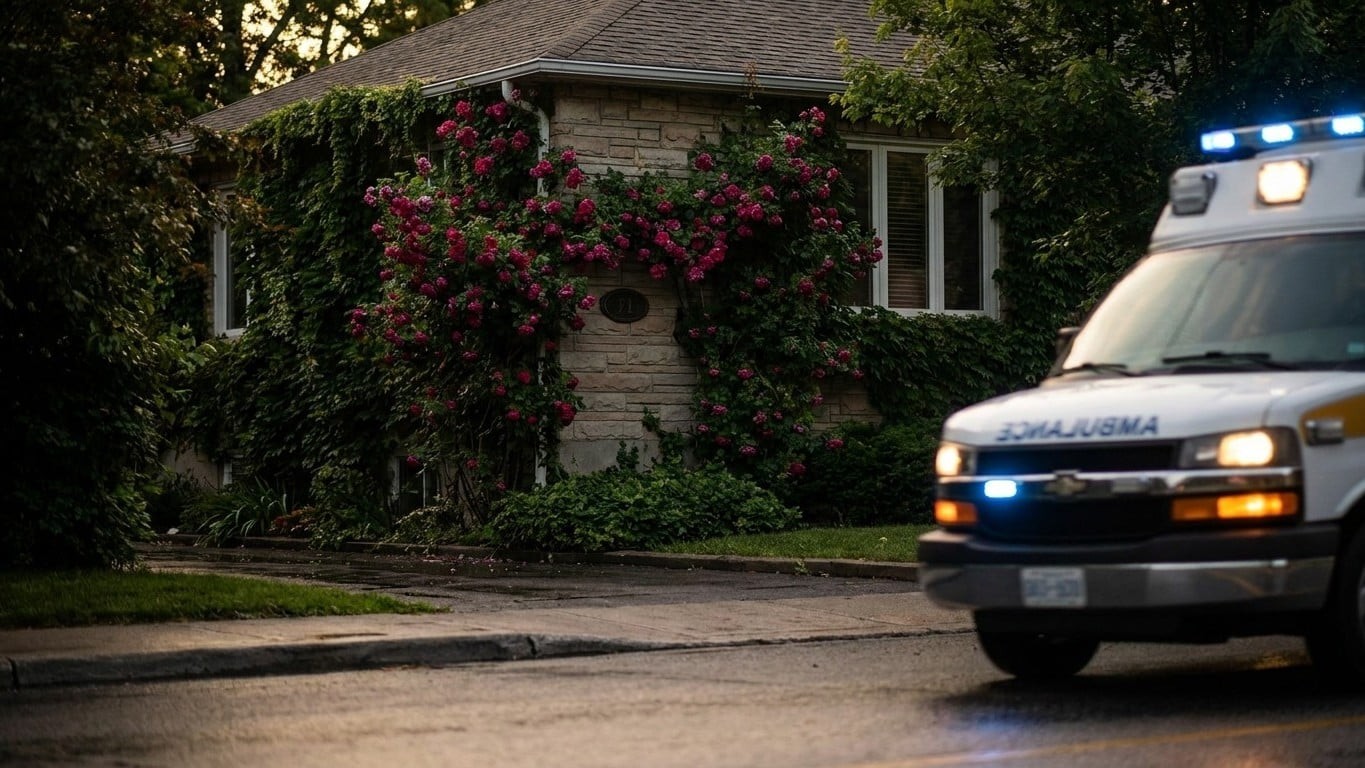
Three emergency vehicles circle a quiet residential street on a hot summer night. They aren’t there for fun. They are hunting for a house number that has vanished behind an unchecked hedge or a rampant climbing rose. This isn’t a fictional scene. It is the mechanical result of a simple oversight: millions of homeowners treat their gardens as private sanctuaries, forgetting that the curb is a public viewpoint.
The test is brutal in its simplicity. Step outside at dusk. Stand in the middle of the road. Look at your home with the eyes of a SAMU driver who has never been there before. What do you see? Often, nothing. The number, once fixed firmly to the gate or façade, is swallowed by wisteria. It is hidden by laurel that hasn’t seen a pair of shears since spring. Three months of summer growth turn an April address into a July mystery.
“Le temps est très important pour nous.” — A firefighter’s reminder during the 3DS law reforms.
When an ambulance circles three times, you are not witnessing a comical error. You are watching minutes burn. Minutes that could decide the outcome of a stroke or a heart attack.
The Legal Requirement: Visible House Numbering
Affixing your address isn’t just good etiquette for delivery drivers. In France, it is a legal obligation driven by public safety. The competence for numbering buildings and naming streets lies with the municipality. Article L. 2213-28 of the General Code of Territorial Collectivities allows the mayor to mandate house numbering.
The rules have tightened significantly. The law n°2022-217, known as the “3DS law” (Decentralization, Devolution, and Proximity), changed the landscape. It forced all communes to name their streets and number their houses. The deadline for larger towns was January 1, 2024. For smaller communes (under 2,000 inhabitants), the deadline extended to June 1, 2024.
This affects nearly 30,000 communes across the country. The goal was standardization. The result is a clear expectation: your number must be visible from the public road. It must be legible. It must withstand the weather. If it is hidden behind foliage, it does not exist.
The Penalty for Non-Compliance
There is a cost to neglect. If you ignore the regulation, you face a fine of 38 euros. This is a second-class contravention. The amount seems trivial. It is a nuisance fee. But consider the context.
The fine is for hiding your identity from emergency services. It is for creating a barrier when speed is the only metric that matters. The risk of ignoring this rule is not just financial. It is moral. It is the weight of knowing you contributed to a delay.
The Weight of Delayed Minutes
We aim for 90% of priority interventions to happen within 15 minutes. For the most critical cases, the target is often cited as 7 minutes. The reality is messier. National medians for priority calls sit between 10 and 18 minutes. The variance is stark depending on location.
An study by Que Choisir highlights this disparity. In the Aude, response times for person rescue and accidents stretch to 21 minutes. In the Alpes-de-Haute-Provence, it is 20 minutes. In Aisne or Rhône, you might see 11 minutes. Seven minutes. Eleven minutes. Fifteen minutes.
Every minute is accounted for in the budget. Every minute is counted in the outcome. When an ambulance loses time searching for a number hidden by a climbing rose, you are adding a variable to a system already under extreme pressure. You did not choose this delay. But you enabled it.
The clock is always running. Your garden is not a shield. It is a screen. And right now, someone is looking for what is behind it.
Fix Your Address Before Autumn Hits
Good news. You can solve this in ten minutes. Grab a pair of shears. That is all you really need.
Think about how a paramedic approaches your house at 2 AM. Rushed. Dark. Eyes scanning for a sign. Do they find it? Check from the street. Stand back. Squint.
- Can you read the number without ducking through bushes?
- Does a vine or hedge swallow the plaque?
- Is there enough contrast when the streetlights flicker on?
- Is the path to the door clear for a stretcher?
The last point matters just as much as the digits themselves. Emergency responders need to reach you. They need space to work. If your gate is blocked by overgrown shrubs, the numbers might as well not exist.
Place the number on the facade. Near the main entry. Keep it between 2 and 4 meters high. Day or night, it must pop. Contrast is key. Light background, dark numbers. Or vice versa.
That pretty rose bush? It looked fine in June. By August, it might be hiding your entire entrance. You don’t see it because you never look at your own house from the outside with stranger’s eyes. You walk past it every day. Blind to the clutter.
This isn’t just about aesthetics. It’s about safety. And in rural areas, it’s becoming a legal mandate.
The 3DS law changed everything. Before that, roughly one million buildings in France had no official address. No signage. No help coming fast. La Poste officials confirmed this gap during the reform rollout.
In some villages, the problem isn’t just a trimmed hedge. It’s total invisibility. No repères for rescuers. The law is fixing this, commune by commune. Slowly.
Don’t wait for the call. Check your address now. Cut the branches. Clean the plaque. Make sure the path is open.